Wire · Berlins Today
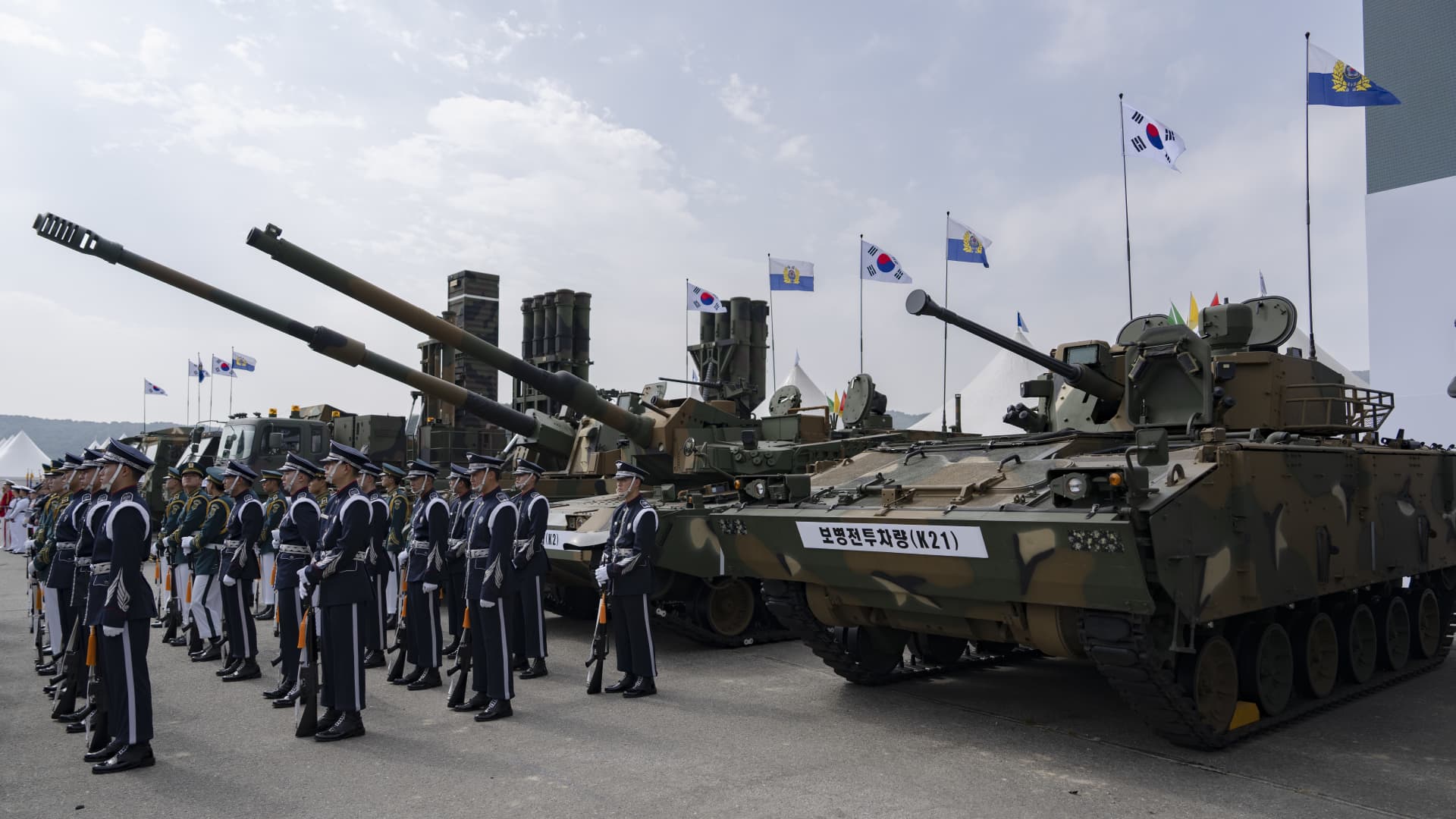
Honor guard members stand in formation next to K21 infantry fighting vehicles and other armored military equipment during a media day event for the 78th Armed Forces Day ceremony at the Gyeryongdae runway in Gyeryong, South Chungcheong Province, South Korea, on September 29, 2026. (Photo by Chris Jung/NurPhoto via Getty Images) Nurphoto | Nurphoto | Getty Images South Korean defense stocks rode a wave of global rearmament over the past two years. Russia’s invasion of Ukraine accelerated military spending across Europe. South Korean companies drew buyers with weapons that were competitively priced and could be delivered relatively quickly, including tanks, artillery and missile systems.
But that rally has given way to a sharp sell-off, with shares of several major South Korean defense companies plunging this year. The combined market value of the top four Korean defense companies — Hanwha Aerospace, LIG D&A, Hyundai Rotem, and Korea Aerospace — had plunged to about 62 trillion won ($46.18 billion) as of end-October from their 52-week peak of 170 trillion won, according to South Korean broadcaster SBS. Are South Korean companies, known for exporting tanks and artillery systems, well-placed for a modern battlefield that has seen drones and counter-drone systems proliferate in Ukraine and Iran?
The war in Ukraine has shown how relatively inexpensive drones can threaten expensive military equipment, and drone strikes from Iran have depleted stocks of costly air defense missiles of the U.S. and its Gulf allies. "Modern warfare is being fought with less traditional weaponry (tanks, cannons, armored vehicles, etc.), which Koreans are positioned for. Even on this front, drones, for example, are dominated by China, pricing out other potential competitors from Europe, the U.S., and Asia," said Peter Kim, senior managing director at KB Securities.
KJ Hwang, Korea autos & industrials analyst, at Bank of America agreed that procurement priorities were evolving, with more focus on drones, counter-drone systems and air defense. Short-term downturn? The reversal in defense stocks is not all down to new warfighting platforms.
The declines come as investors weigh several concerns: disappointing earnings, a stronger won and delayed export orders. Fund flows into the semiconductor sector and high valuations built on expectations of strong earnings growth have also weighed on Korean defense shares, said KB Securities' Kim, adding that governments have moved slower than expected to convert defense spending pledges into approved budgets and orders. Financial results have amplified those concerns.
Hanwha Aerospace’s third-quarter operating profit fell over 46% from a year earlier, with the company citing delivery-schedule adjustments and one-off costs. Its shares are down more than 28% so far this year. Hyundai Rotem, which reported a more than 11.1% decline in operating profit, has seen its stock drop almost 60%.
Korea Aerospace Industries’ third-quarter sales and operating profit improved about 52% and 32% respectively, limiting the decline in its shares to just over 8% this year. Experts, however, are still positive on the sector, especially over the long-term. "South Korean defense companies have continued to expand cooperation with partners in Western Europe and the Middle East, including in air-defense systems, while additional K9 howitzer orders suggest that supply constraints and the continued importance of deterrence remain supportive of demand for conventional platforms," BofA's Hwang said.
Some deals made this year include K9 orders to Spain from Hanwha Aerospace, valued at about 546 million euros , as well as a $922 million order for K239 rocket systems from Norway. LIG D&A has made a $94 million deal with Malaysia for its K-SAAM naval surface-to-air guided missile system, the first export deal of the system ever made. Countries still rely heavily on conventional weapons to bolster their defense capabilities, with KB Securities' Kim saying that the Korean defense sector "remains attractive, given the long-term growth outlook is still in the teens." David Roche, strategist at Quantum Strategy, told CNBC that there is a "greater emphasis" on AI and drone technology in military orders as major powers learn the lessons of Ukraine, however, “drones cannot capture and hold terrain ...
So, in any mobile battlefield, infantry, tanks, armor etc, are essential." South Korean defense companies are also actively investing in drones and unmanned systems, and while meaningful exports will take time as overseas buyers require a proven operational track record, Kim expects more tangible results potentially emerging in the near future.
Source: CNBC